Millwright
Field & Trades
Installs, aligns, and maintains the heavy industrial machinery inside a facility, an entry point into manufacturing and industrial construction most newcomers never hear about.
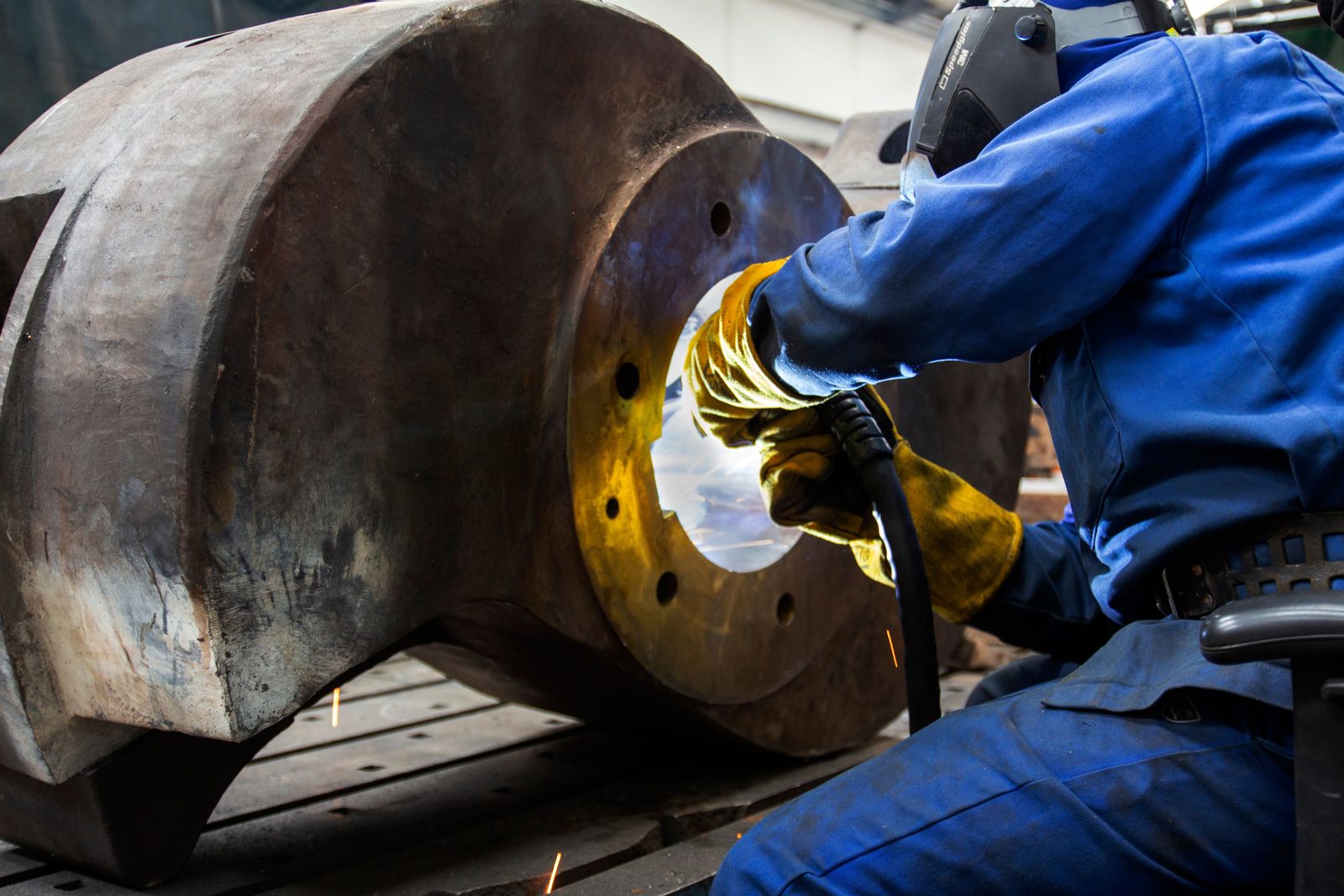
What is a Millwright?
A Millwright installs, aligns, and maintains heavy industrial equipment, conveyors, pumps, gearboxes, turbines, and production machinery, inside manufacturing plants, power facilities, and other industrial buildings. It's precision work: aligning a piece of rotating equipment can come down to thousandths of an inch, checked with dial indicators or laser alignment tools, because equipment installed out of tolerance wears out or fails early. Millwrights typically get involved once a building's structural shell and utilities are in place and it's time to install the equipment the building was actually built to house.
What they do
- Rig, move, and set heavy industrial equipment using cranes and rigging
- Align rotating equipment (motors, pumps, gearboxes) to precise tolerances using dial indicators and laser alignment tools
- Install and level conveyors, production machinery, and process equipment
- Read mechanical drawings to plan equipment placement and anchoring
- Troubleshoot and repair mechanical equipment failures
- Perform preventive maintenance on installed machinery
A typical day
- 6:00 AMReview the day's equipment installation plan and rigging requirements
- 7:00 AMRig and set a piece of production machinery into its final position
- 10:00 AMLaser-align a motor and pump coupling to the tolerances specified by the manufacturer
- 1:00 PMRead mechanical drawings to plan anchor bolt layout for an upcoming equipment set
- 3:00 PMPerform preventive maintenance checks on previously installed conveyor equipment
Skills
Software
Pay expectations
Pay by experience, nationally
as of May 2025
Source: U.S. Bureau of Labor Statistics, Occupational Employment and Wage Statistics (OEWS), Millwrights (SOC 49-9044), national data
Reviewed May 2025. Pay reflects the national wage distribution for this occupation, not a promise for any one job: entry level is the lower part of that range, 5 years in sits around the national median, and 10 years in is the upper part, since pay isn't actually tracked by years on the job. Real pay varies a lot by state, metro area, union status, and employer — scale these up or down for your market. These figures are base pay only: overtime, shift differentials, and per-project bonuses are standard across most construction trades and routinely push real earnings above what's shown here.
Education
- Required:
- High school diploma or equivalent, then a registered apprenticeship (through a union such as the United Brotherhood of Carpenters or the International Union of Operating Engineers, depending on region) or an NCCER Millwright curriculum, a four-level, roughly 670-800 hour program covering rigging, alignment, and mechanical systems that's built to meet U.S. Department of Labor apprenticeship standards; millwright work isn't separately state-licensed
- Helpful:
- OSHA 10 or 30 certification (not a nationwide legal requirement, though several states, including New York, Massachusetts, Connecticut, Nevada, Missouri, and Rhode Island, legally require it for workers on public construction projects), and rigging or crane signal-person certification given how much of the work involves moving heavy equipment
- Not necessary:
- A four-year college degree; the apprenticeship-to-journeyman route is the standard path into the trade
Career progression
- 1.Apprentice Millwright
- 2.Journeyman Millwright
- 3.Millwright Foreman
- 4.Maintenance Superintendent or Industrial Contractor